


Molding Processes
Injection molding, compression molding, and casting are all shaping techniques that involve forcing a polymer into a mold cavity to replicate its geometry. In casting, the mold cavity is filled by gravity with a low-viscosity liquid—such as a reactive monomer or prepolymer—which solidifies after polymerization. In compression molding, a solid prepolymer is heated or melted and then forced to flow under pressure as the hot mold closes, producing the final shape. During this process, the material typically undergoes cross-linking and permanently retains the geometry of the cavity.
In injection molding, the polymer melt is forced through a gate into a cold, closed mold where it solidifies under pressure. Sequential injection of two polymers can create skin–core sandwich structures. Additionally, air can be introduced into a partially filled mold and pressurized to form a polymer skin–air core structure through gas-assisted injection molding. In all injection molding processes, melting, mixing, and injection occur in the injection unit of the machine.
Reaction injection molding (RIM) is a variation of the casting process. In RIM, low-viscosity monomers or prepolymers are thoroughly mixed immediately before being injected into a heated mold cavity, where rapid chemical reactions occur, leading to solidification. Unlike traditional casting, RIM involves high-speed injection of highly reactive systems into complex mold geometries, enabling fast shaping and curing.
Injection Molding
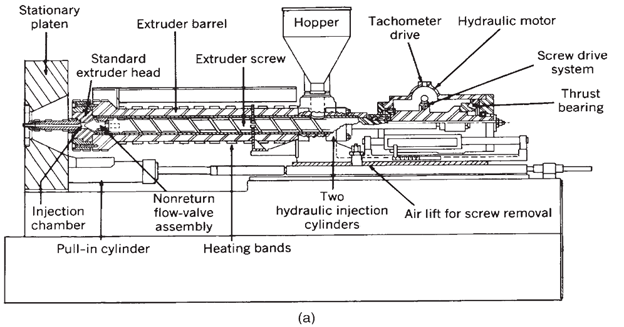
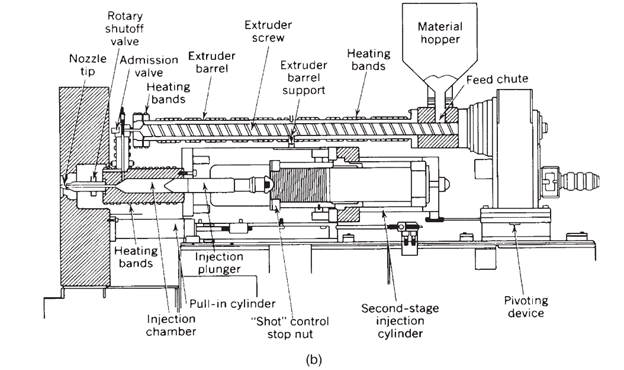
The injection molding process consists of two main stages. The first involves solid transport, melting, mixing, pressurization, and flow within the injection unit of the machine. The second stage involves product shaping and structuring inside the mold cavity. Most injection molding machines use an in-line reciprocating screw system, as illustrated in Fig. (a). However, two-stage injection molding machines are also employed as shown in Fig. (b); in these systems, the polymer melt is produced in an extruder and transferred into a reservoir connected to a hydraulic piston. This piston cyclically pressurizes the melt and delivers it into the mold cavity.
The theoretical analysis of the injection unit is similar to steady-state plasticating screw extrusion but includes transient effects due to intermittent screw rotation combined with axial movement.
In the injection unit the melting step is the dominant one regarding design and operation. Experimental studies have shown that the melting mechanism is similar to that in plasticating screw extrusion, which has been used as the basis for mathematical modeling of the melting process. The molten polymer accumulates in front of the screw, and melt uniformity directly influences both the filling behavior and the final product quality. It is typically assumed that each cycle produces a well-mixed melt with uniform temperature and consistent quality.
To inject the melt into the mold, pressure must be applied. This is achieved by the forward motion of the screw (a) or the hydraulic piston (b), both acting as rams. The result is static mechanical pressurization and a positive displacement flow, ensuring precise and efficient mold filling.
Reactive Injection Molding (RIM)
Injection molding is widely used to produce parts ranging in weight from less than a gram to several kilograms. However, when molding large components, two major challenges typically arise:
(a) generating a sufficient volume of homogeneous melt in the injection molding machine, and
(b) maintaining adequate clamping pressure to keep the mold closed during the filling and packing stages.
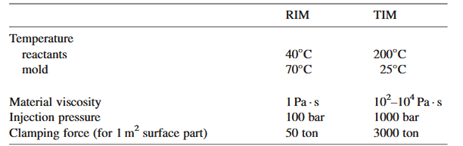
The latter becomes particularly critical for parts with a large projected area, as it requires extremely high clamping forces and expensive molding equipment. The Reaction Injection Molding (RIM) process was developed to address these limitations. In this method, two or more low-viscosity liquid streams (0.1–1.0 Pa·s), which react upon contact, are mixed immediately before being injected into the mold cavity. Polymerization begins during the filling stage and continues after the mold is filled—and often even after the part is removed from the heated mold. Because the reactive mixture has a low initial viscosity, only modest injection pressures are required to fill even large and complex cavities.
As the polymerization progresses, the exothermic reaction generates heat, increasing the specific volume of the system. Simultaneously, polymerization induces a volume shrinkage of approximately 10%. Under conventional processing, this would necessitate packing flows at high pressures, since the viscosity increases rapidly with molecular weight and cross-link density. To overcome this, a small amount of foaming agent is added to one of the liquid streams. The resulting expansion compensates for the shrinkage, ensuring complete cavity filling and precise replication of the mold geometry. This enables the production of large, complex parts using relatively low injection pressures (on the order of 1–10 MN/m²) and smaller, less expensive clamping systems.
A critical factor in the success of the RIM process is achieving sufficiently fast polymerization rates to ensure economic competitiveness with conventional injection molding. If the reaction time is too long, the process resembles casting rather than molding, reducing its commercial advantage. Consequently, only certain polymer systems are well-suited for RIM. Since its commercial introduction in the early 1970s, the most common system has been polyurethane, based on reactions between di- or tri-alcohols and di- or tri-isocyanates. Other systems include fiber-filled polyesters, polyureas, nylon 6 (via ring-opening polymerization), polyesters, polyacrylamides, and epoxies.
Because RIM involves reactions between miscible liquid reactants, precise process control is essential. The equipment must:
(a) maintain accurate temperature control of both reactant streams,
(b) ensure highly accurate stoichiometric metering of the reactants, and
(c) provide nearly instantaneous and intimate mixing within a mixhead prior to injection into the heated mold.
Compression Molding
Compression molding involves placing a thermoplastic or a partially polymerized thermosetting polymer into a heated mold cavity. Typically, the material is preheated and preformed into a shape roughly corresponding to that of the final part. As the mold closes, pressure is applied to the preform, causing it to heat further to the mold temperature and flow to completely fill the cavity. During this stage, thermosetting materials undergo full polymerization and cross-linking. Once curing is complete, the mold is opened, the part is ejected, and the cycle repeats.
This process is characterized by minimal material waste, as it does not require runners or sprues, and it is well-suited for manufacturing large components. However, achieving tight dimensional tolerances can be challenging, since the final dimensions of the molded part depend on the precise amount of material in the preform. Additionally, compression molding is less suitable for producing complex geometries with deep undercuts, which are difficult to mold accurately using this method.
